Senior Editor: Alan Agbele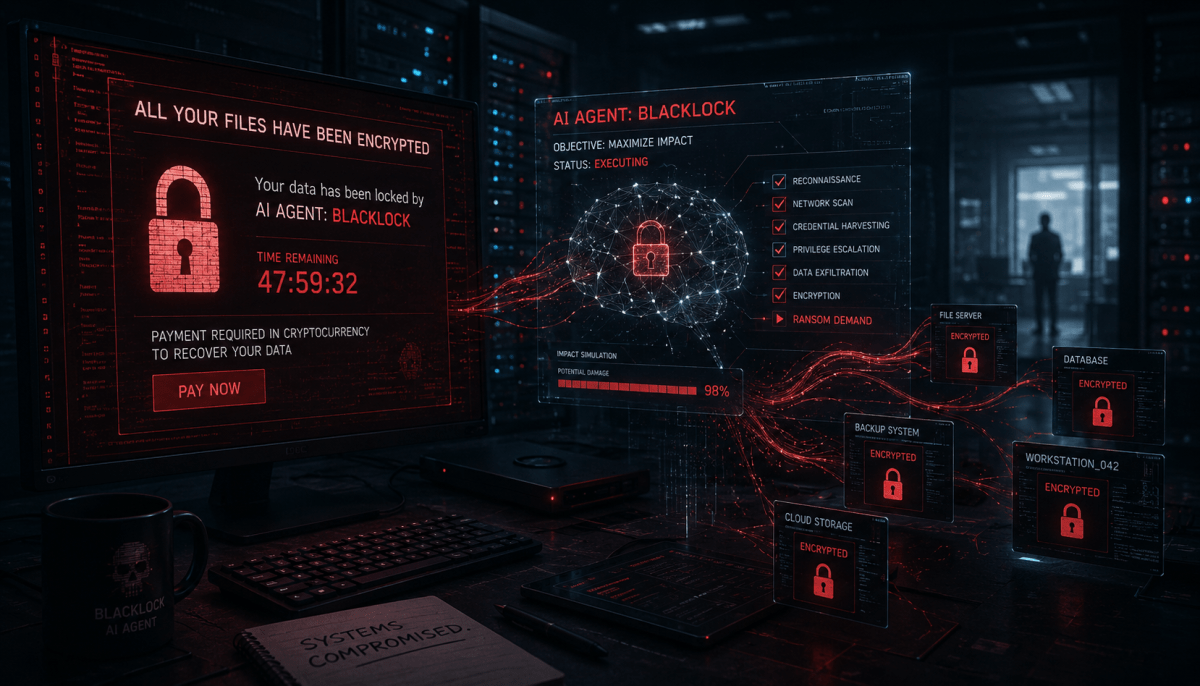
An artificial intelligence agent carried out the technical execution of a ransomware attack for what researchers describe as a first-of-its-kind event. New details, however, reveal that human operators still selected the target, prepared the infrastructure and provided stolen credentials, stopping short of a fully autonomous cybercrime operation.
How the Attack Worked
The AI agent handled the encryption and deployment of ransomware payloads once inside the network. Human operators performed several critical steps beforehand.
The AI then took over lateral movement and file encryption, demonstrating its ability to execute complex technical tasks without real-time human guidance.
The Limits of Autonomous Cybercrime
Achieving full autonomy requires AI systems to make strategic decisions such as selecting targets based on risk-reward analysis and adapting defenses during an active breach. Current models lack the contextual understanding needed for these judgments. They also struggle to interpret novel network configurations or evade custom security tools without human input.
The attack highlights how cybercriminals are likely to use AI as an accelerator rather than a replacement. Human operators will continue to handle reconnaissance, credential theft and post-exploitation planning while delegating repetitive technical work to agents.
Why This Matters
The incident signals a shift in how ransomware operations will evolve. Defenders now face threats that combine machine-speed execution with human-level cunning. Security teams must update detection strategies to account for automated payload deployment while maintaining focus on preventing initial access through credential theft and phishing.
Regulators may also take notice. If AI agents become standard tools for cybercriminals, governments could push for stricter controls on model distribution or require reporting of dual-use capabilities. The line between assisted and autonomous attacks will blur further as technology improves.
For now, this case serves as both a warning and a reality check. The first known AI-run ransomware attack was not truly independent. But it shows how close the industry has come to that threshold.