Senior Editor: Alan Agbele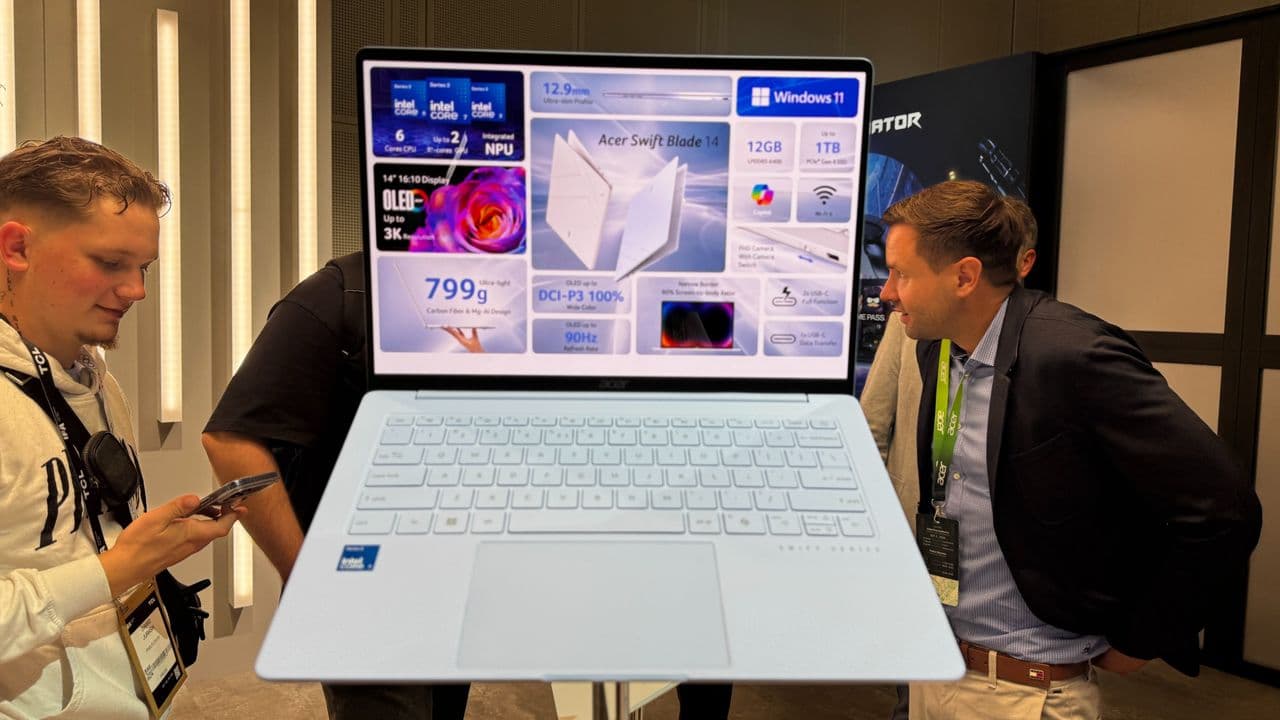
Ahead of the IFA tradeshow, Acer has introduced a new lightweight laptop sub-brand called Swift Blade, starting with the Swift Blade 14 that weighs just 1.76 pounds and runs on Intel’s Wildcat Lake processors. The company also refreshed its Swift Air lineup with a 16-inch model. Both systems target mid-range buyers seeking thin, portable designs without flagship prices.
New Sub-Brand and Featherweight Design
The Swift Blade name marks a fresh direction for Acer’s Swift line. By blending aluminum-magnesium alloy with carbon fiber, the company has trimmed the chassis to just 0.51 inches at its thinnest point. The result is a 14-inch laptop that weighs 799 grams (1.76 pounds), making it one of the lightest in its class. Available colors include marshmallow white and marshmallow blue.
Intel’s Wildcat Lake architecture powers the system, with options spanning from the Core 3 304 to the Core 7 350. These chips integrate Intel Graphics, so there is no discrete GPU. The laptop ships with 12GB of soldered LPDDR5 RAM and up to 1TB of PCIe Gen 4 NVMe storage. Display choices include a 2880x1800 OLED panel at 90 Hz or a 1920x1200 IPS LCD screen.
Swift Air 16 and Portfolio Expansion
Alongside the Swift Blade, Acer unveiled the Swift Air 16, a larger version of the Swift Air 14 shown at Computex. It features an aluminum build, Thunderbolt 4 ports and a 100W power adapter. The 16-inch model offers OLED display options with up to 600 nits brightness and a 120 Hz refresh rate, plus quad-speaker audio. Color choices include elemental blue, sage green and sandstone gold, though U.S. availability may be limited to sage green.
The Swift Air 16 uses the same Intel Wildcat Lake chips as the Swift Blade 14 but with up to 16GB of LPDDR5x RAM and up to 512GB of storage. It packs a larger 70 WHr battery and supports Wi-Fi 6E. Both the Swift Blade 14 and Swift Air 16 will come with a 1080p webcam, though only the Air model includes an IR sensor for Windows Hello.
Why This Matters
Acer’s new sub-brand and expanded Swift Air lineup signal a shift in the mid-range laptop market: weight and portability are becoming differentiators even at lower price points. By using Intel’s Wildcat Lake chips, Acer can keep systems thin and cool without sacrificing everyday performance. This move pressures competitors like Dell and Lenovo to offer similarly light machines under $1,000. For consumers, the trade-off is soldered RAM and limited expandability, but the benefit is a truly backpack-friendly device that does not compromise on screen quality or battery life. The Q1 2027 launch window also suggests these laptops will compete directly with next-generation Snapdragon and AMD Ryzen designs, making the ultraportable segment even more crowded.